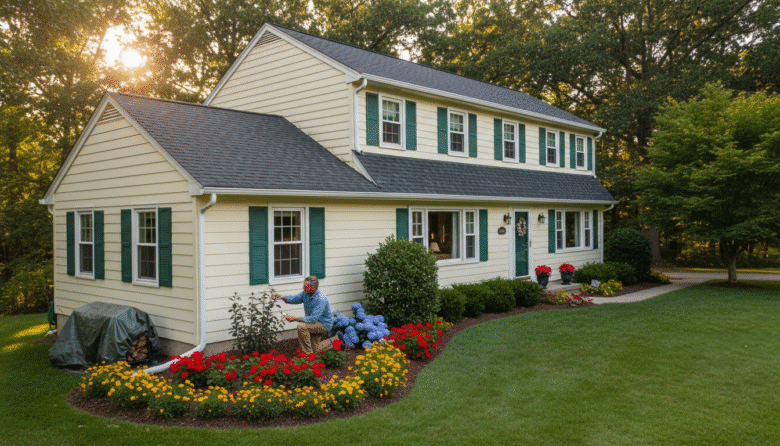
A well-maintained home doesn’t just look better — it lasts longer, costs less to operate, and holds its value when it matters. The problem is that most of the protective actions that make a real difference are invisible when they’re working. You never see the rot that didn’t happen because the paint held. You never get the contractor bill for the window leak that didn’t occur because the caulk was in good shape. The savings from consistent maintenance are real, but they’re the absence of a cost — which makes them easy to overlook and easy to skip.
This guide focuses on eight specific protection habits — each one requiring minimal time and money, each one preventing damage that costs orders of magnitude more to repair. These aren’t emergency response protocols. They’re the small, recurring actions that keep your home’s structural and physical systems functioning for decades.
The Caulking Calendar: Where and When to Recaulk
Caulk is one of the most underappreciated protective materials in a home. It seals the joints and transitions between surfaces where water — and air — would otherwise enter. When caulk fails, water finds a way in. That water saturates substrates, feeds mold, and eventually reaches the structural framing that everything else depends on.
Where to Inspect and Recaulk Annually
- Tub and shower: The bead where the tub deck meets the tile wall, and where the tile meets the floor in a shower. These joints flex every time the tub or shower pan flexes under body weight. That movement eventually cracks rigid caulk. Look for gaps, cracking, dark staining (mold), or sections where the caulk has pulled away from the surface. Failed tub caulk allows water behind the tile, saturating the cement board or drywall substrate and eventually rotting the subfloor. Recaulking a tub takes 45 minutes and costs $5–$10 in materials.
- Windows — interior and exterior: The bead where the window frame meets the interior drywall or trim (interior) and where the window frame meets the exterior siding or trim (exterior). Exterior window caulk is exposed to UV, freeze-thaw cycles, and rain. It typically lasts 5–10 years with quality products and 2–4 years with builder-grade material. Look for cracking, shrinking, or sections where the caulk has separated from either surface.
- Exterior door frames: The joint between the door casing and the siding, and the sill-to-threshold transition. These are common water entry points during driven rain.
- Exterior trim and penetrations: Where any pipe, wire, or duct penetrates the exterior wall, and where horizontal trim elements like window sills meet the vertical siding. These are high-risk points that most homeowners never inspect.
How to Do It Properly
The single most common caulking mistake is applying new caulk over failed old caulk. The new bead won’t bond to the old material — it bonds to a surface that is already failing, and it will peel or crack within months. Always remove the old caulk first using a caulk removal tool (a $5–$10 plastic or metal tool that cuts and lifts old beads without damaging surfaces) or a utility knife, then clean the joint with isopropyl alcohol before applying the new bead.
For wet areas (tubs, showers, sinks), use 100% silicone caulk or a siliconized latex caulk rated for kitchens and baths — these flex without cracking and resist mold. For exterior use, use a high-quality paintable acrylic latex caulk or a polyurethane sealant (OSI Quad or similar) that bonds to multiple substrates and withstands UV exposure. Apply in a smooth, continuous bead, tool it with a wet finger or caulk tool within 5 minutes, and allow full cure time before water exposure.
Weatherstripping Inspection: How to Test and Replace
Weatherstripping seals the gap between a movable door or window sash and its fixed frame. When it’s working, it blocks air infiltration (which drives up heating and cooling costs) and keeps water out at the threshold and jamb. When it fails — and all weatherstripping fails eventually, typically in 5–10 years — you’re conditioning outdoor air and potentially allowing moisture infiltration at the sill.
Testing for Draft Failure
The paper test: Close the door on a sheet of printer paper. If you can pull the paper out with minimal resistance, the weatherstripping at that point is not sealing adequately. A good seal should grip the paper firmly enough that pulling it requires some effort.
The candle or incense test: On a windy day, hold a lit candle or incense stick near the interior perimeter of a closed exterior door or window. Any flickering or smoke movement indicates a draft. Move slowly around the entire perimeter — drafts are often localized to corners, hinge sides, and the bottom sweep.
How to Replace It
Weatherstripping comes in several types, and matching the replacement to the original is important. Door jamb weatherstripping is typically a V-strip or foam tape product that compresses when the door closes — sold in rolls or pre-cut lengths at any home center. Door bottom sweeps are screwed to the bottom of the door face; the sweep element (usually rubber or brush) is often replaceable separately from the carrier. Threshold seals (the rubber or vinyl element embedded in the threshold) compress against the door bottom and are typically replaceable by unscrewing the threshold and pressing in a new seal.
A complete weatherstripping replacement on one exterior door typically takes 30–45 minutes and costs $15–$40 in materials. The energy savings — reduced heating and cooling loads — commonly recoup the cost within one heating or cooling season.
Paint as Protection: Why Exterior Paint Is a Structural Issue
Paint is not just cosmetic on the exterior of a home. It is the primary moisture barrier protecting every inch of wood trim, siding, and fascia. When paint fails — when it chalks, cracks, peels, or pulls away from the substrate — the wood beneath is directly exposed to rain, UV, and freeze-thaw cycling. Wood rot follows within months to years depending on climate and exposure.
On a wood-sided home, plan to repaint the entire exterior every 7–12 years depending on climate, paint quality, and sun exposure. South and west faces of the home — those receiving the most UV and afternoon sun — fail first and may need attention every 5–7 years. Touch up cracked, peeling, or chalking sections immediately — don’t wait for the full repaint cycle if localized sections are failing.
Inspection Tips
Walk the exterior perimeter once a year in spring or fall. Look specifically at: the bottom edges of siding panels and boards (the most moisture-vulnerable points), the end grain of trim boards at corners and transitions (end grain absorbs moisture preferentially), and areas above horizontal surfaces like window sills and door hoods where water can pool. Press any suspect areas with your thumb — soft or spongy wood means rot has already begun. Probe with a screwdriver tip: if it sinks into the wood with minimal pressure, the rot is deep enough that replacement is necessary.
On painted wood windows, inspect the glazing compound (the putty that holds glass panes in wooden sash frames). Cracked or missing glazing compound allows water behind the glass, which leads to sash rot. Re-glazing a window costs $5–$10 in materials and 30 minutes per sash.
Grout Sealing: Why Grout Fails and How to Prevent It
Grout is a cement-based material — porous by nature. Without sealing, it absorbs water, soap, oils, and organic material. In showers, this means mold and mildew grow within the grout itself, not just on the surface. In kitchen tile backsplashes, it means grease penetrates and permanently stains. Over years, unseal grout deteriorates structurally: it becomes soft, crumbles, and eventually develops voids through which water reaches the substrate behind the tile.
Grout should be sealed when it is installed and resealed every 1–2 years in high-moisture areas (shower floors, tub surrounds) and every 3–5 years in lower-moisture areas (kitchen backsplashes, bathroom floors outside the shower). Sanded grout (used for joints over 1/8 inch wide) needs more frequent sealing than unsanded grout because its rougher texture provides more surface area for moisture infiltration.
Grout sealers come in two types: penetrating sealers (also called impregnating sealers) and topical sealers. Penetrating sealers soak into the pores of the grout and create an internal barrier — they don’t change the appearance and are the better long-term choice. Topical sealers form a surface film that wears off faster and can create an uneven sheen. For showers and wet areas, use a penetrating silicone or fluoropolymer-based sealer — brands like Aqua Mix Sealer’s Choice Gold and Miracle Sealants 511 Impregnator are widely used and available at tile supply stores and home centers.
Testing whether grout needs resealing: put a few drops of water on the grout surface and watch for 3–5 minutes. If the water beads up, the sealer is still active. If it absorbs within 1–2 minutes, it’s time to reseal.
Gutter Maintenance Schedule
Gutters and downspouts are the primary drainage system for your roof — in a typical rainstorm, hundreds of gallons of water flow off the roof and must be channeled away from the foundation. A clogged or disconnected gutter defeats this entirely, allowing that water to cascade over the fascia, saturate the foundation perimeter, and in winter, back up under shingles as ice dams.
Cleaning Schedule
Clean gutters at minimum twice a year: once in late spring (after flowering trees have finished dropping petals and seeds) and once in late fall after leaves have fully dropped. In areas with heavy tree canopy overhead, clean three to four times per year. A blocked gutter can overflow within minutes during a heavy rain, and even partial blockages cause standing water in the trough that accelerates corrosion and provides breeding grounds for mosquitoes.
For DIY cleaning: use a ladder, work gloves, and a gutter scoop (a curved plastic scoop sized to fit the gutter channel, available for $5–$10). Work from the far end toward the downspout opening. After clearing debris, flush the gutter with a garden hose to verify the downspout flows freely. A downspout that drains slowly despite a clear gutter likely has a blockage partway down — clear it with a plumber’s auger or high-pressure hose attachment.
Downspout Extension Placement
Downspouts should terminate at least 4–6 feet from the foundation, discharging onto a splash block or into an extension that carries water further. Flexible downspout extensions (corrugated plastic, $5–$15 each) are simple and effective. In yards with adequate slope, a pop-up drain emitter at the end of a buried downspout extension keeps the water moving underground and away from the house — a cleaner solution that keeps the extension from being a tripping hazard. Verify extension positioning every spring — they can shift over winter or be moved by lawn care.
Concrete and Driveway Crack Monitoring
Not all concrete cracks are created equal. Learning to read what you’re looking at prevents unnecessary alarm on one end and missed serious problems on the other.
Hairline cracks (under 1/4 inch wide, no vertical displacement between the two sides of the crack) are normal in concrete and are typically caused by curing shrinkage or seasonal thermal expansion. They should be sealed to prevent water infiltration — water that enters and freezes expands the crack (freeze-thaw spalling) — but they don’t indicate structural failure. Use a concrete crack filler or polyurethane sealant for these: Quikrete Concrete Repair (squeeze-bottle format) or Sashco Cleaver polyurethane sealant work well.
Cracks with vertical displacement — where one side of the crack is higher than the other — indicate soil movement or settlement beneath the slab. Small displacement (under 1/4 inch) can often be addressed by mudjacking or polyurethane foam leveling, which injects material under the slab to re-level it. Cost: $500–$1,500 depending on size and number of slabs. Larger displacement or cracks that are actively growing require professional structural assessment.
Wide cracks (over 1/2 inch) in driveways or walkways that extend through the full slab thickness may indicate that the slab has lost structural integrity and needs section replacement. Monitor these with a pencil mark and date: if the crack grows in length or width over 3–6 months, replacement is likely the better long-term investment over repeated patching.
Roof Flashing Inspection From the Ground
You don’t need to get on the roof to conduct a useful flashing inspection. A pair of 7×50 or 10×50 binoculars gives you a clear view of all the critical areas from the safety of the ground. Do this once a year — ideally in spring after winter stress and before the main rainy season in your climate.
What to Look For
- Chimney flashing: Look for the step flashing (L-shaped metal pieces layered up the chimney sides) separating from the masonry, and the counter flashing (embedded in the mortar joints) pulling away. Any gap between flashing and masonry is a water entry point. Also look at the saddle or cricket (the small ridge behind the chimney that diverts water around it) for damage or missing sections.
- Pipe boot flashings: Rubber or lead boots seal the joint between a pipe penetrating the roof (plumbing vents, gas flues) and the roofing surface. Rubber boots crack, harden, and pull away from the pipe over time — typically at 10–15 years on the original installation. A cracked pipe boot looks like a split ring at the base of the pipe. These are inexpensive to replace ($15–$40 per boot) but cause significant water damage if ignored.
- Valley flashing: The metal or woven membrane in the V-shaped valley where two roof planes meet. Look for lifted edges, holes, or rust staining on metal flashing.
- Skylight perimeter: The flashing kit around a skylight is one of the most common leak sources on any home with skylights. Look for visible gaps, caulk that has dried and cracked at the interface between the skylight frame and the roof surface, and for any staining on the exterior that suggests water running down the wrong path.
If you see something concerning from the ground, either hire a roofing contractor to inspect and repair (a basic flashing repair typically costs $200–$600) or get on the roof yourself if you’re comfortable doing so safely — with roof shoes, a safety harness anchor, and dry weather conditions only.
HVAC Filter as System Protection: The MERV Rating Guide
The air filter in your HVAC system has one primary job: keep particulates out of the air handler, blower motor, evaporator coil, and ductwork. A filter that is too dirty to do that job — or too restrictive for the system’s airflow design — causes progressive damage to the equipment it’s supposed to protect.
MERV Rating Guide
MERV (Minimum Efficiency Reporting Value) rates how effectively a filter captures particles of various sizes. Higher MERV = finer filtration = more airflow restriction. The key is matching the filter to both your indoor air quality needs and your system’s designed airflow capacity.
- MERV 8: Captures dust, pollen, and most common household particles. Appropriate for most standard residential systems. Minimal airflow restriction. Replace every 60–90 days. This is the baseline recommendation for most homes.
- MERV 11: Captures finer particles including pet dander, mold spores, and fine dust. Good for homes with pets or allergy sufferers. Moderate airflow restriction — verify your system is rated for MERV 11 before upgrading, as older systems may not handle it efficiently. Replace every 60–90 days.
- MERV 13: Hospital-grade filtration. Captures very fine particles including some bacteria and smoke particles. Significant airflow restriction — only use if your system is specifically designed for it (newer high-efficiency systems). Replace every 30–60 days.
- Fiberglass panel filters (MERV 1–4): These protect the equipment from large debris but do virtually nothing for air quality. They have essentially no filtration value for particulates. Avoid unless your contractor specifically recommends them for an older, airflow-sensitive system.
Replacement Schedule
The standard recommendation of “replace every 90 days” assumes average conditions. Adjust based on your home: homes with pets, occupants with allergies, or in dusty climates may need monthly replacement. Vacation homes with minimal occupancy can go 6 months. A simple way to check: hold the filter up to a light source. If you can’t see light through it, it needs replacing regardless of the time elapsed.
Subscribe to a filter delivery service (Second Nature, FilterEasy, or Filter King all offer subscription models where filters arrive on your chosen schedule) to eliminate the “I keep forgetting to buy filters” issue that leads to years of neglect. A subscription for standard 1-inch filters typically costs $15–$30 per filter, with delivery timed to your replacement schedule.
The best protection for your home is invisible — it’s the water that never entered, the rot that never started, the system that ran clean because a filter was changed on time. Small habits create the conditions where big failures simply don’t occur.
Annual Protection Habit Checklist
- Every 1–2 years: Reseal grout in showers and wet areas; recaulk tub and shower joints; recaulk exterior windows and doors
- Every year: Inspect and test weatherstripping on all exterior doors; clean gutters twice (spring and fall); extend downspouts as needed; inspect exterior paint and touch up peeling sections; inspect roof flashing from ground level with binoculars; walk driveway and concrete paths for new cracks and seal hairline cracks
- Every 1–3 months: Replace HVAC filter per MERV rating and household conditions
- Every 5–7 years: Reseal concrete driveway; repaint south- and west-facing exterior trim; consider full exterior recaulk as part of any exterior repaint project

Ava Harrington is a home improvement writer and DIY enthusiast with over eight years of hands-on experience maintaining, renovating, and documenting residential properties across the United States. She writes practical, no-fluff guides on home care, preventive maintenance, and everyday repairs — helping homeowners protect their properties without overspending or overcompleting.