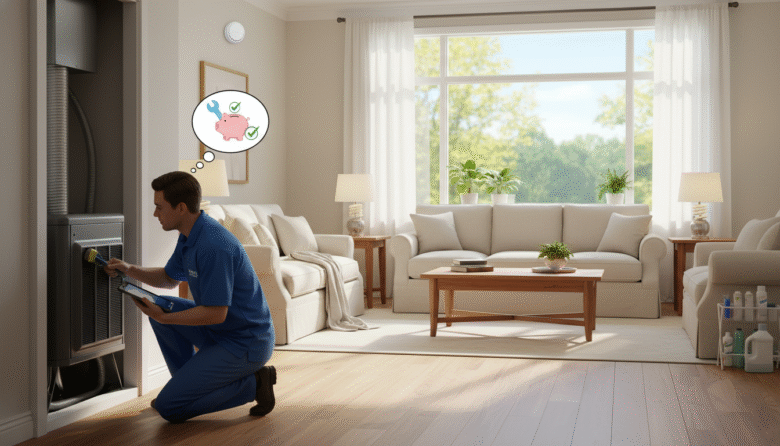
Home repair spending in the United States averages over $6,000 per household per year. A significant portion of that figure is avoidable — not because repairs don’t need to happen, but because most expensive repairs are the direct result of smaller, cheaper repairs that were ignored or delayed. A $10 tube of caulk becomes $3,000 in water damage remediation. A $5 toilet flapper becomes $800 in wasted water. A $15 air filter becomes a $3,000 HVAC replacement.
This article breaks down the strategy behind catching problems early, budgeting for maintenance intelligently, and making the right call on which repairs to DIY versus which to hire out.
Why Small Fixes Prevent Big Bills: The Cost Comparison Reality
The cost asymmetry in home repair is striking once you lay it out clearly. Here are some of the most common examples of small, ignored problems turning into large, expensive ones:
- Failed window or door caulk ($10 caulk tube) vs. water damage remediation ($3,000–$10,000): A gap in the caulk around a window allows water to enter the wall cavity. Over months, that moisture saturates insulation, causes wood rot in framing members, and creates conditions for mold growth. Mold remediation alone typically costs $1,500–$5,000 for a contained area, and structural repairs to rotted framing add thousands more. A 20-minute recaulk prevents all of it.
- Worn toilet flapper ($5–$8) vs. wasted water ($600–$1,200+ per year): A flapper that doesn’t fully seal allows the tank to continuously trickle water into the bowl — sometimes too slowly to hear. The EPA estimates a running toilet can waste 200 gallons per day, or roughly 6,000 gallons per month. At typical residential water rates, that’s $50–$100 per month in pure waste. Over a year, that’s $600–$1,200 added to your water bill before you even call a plumber. Replacing the flapper is a 10-minute job with a $5 part.
- Clogged HVAC filter ($15–$20) vs. HVAC system failure ($3,000–$10,000): An HVAC air filter’s job is to keep dust, debris, and particles out of the air handler, evaporator coil, and blower motor. A filter that has been in place for 12 months instead of the recommended 1–3 months becomes so restrictive that the system is working against significant airflow resistance. This strains the blower motor, reduces heat exchange efficiency at the coil, causes the coil to ice over in cooling mode, and in the worst case, causes the compressor to overheat and fail. Compressor replacement is typically $1,500–$3,500 and often prompts a full system replacement.
- Gutter cleaning ($100–$200 per year) vs. foundation damage ($5,000–$30,000): Gutters exist to channel roof runoff away from the foundation. Clogged gutters overflow along the fascia and dump concentrated water directly against the foundation. Over years, this saturates the soil around the foundation, creating hydrostatic pressure that causes cracks and water infiltration. Basement waterproofing and foundation crack repair easily reaches five figures.
- Roof flashing caulk ($20) vs. roof deck replacement ($2,000–$8,000): Flashing is the metal that seals the joints between the roof surface and vertical elements — chimneys, vents, skylights. When the caulk at flashing joints fails, water enters at the joint, saturates the roof deck, and begins rotting the sheathing from the inside. By the time it shows up as a water stain on the ceiling below, substantial damage has already occurred.
The Catch-It-Early Matrix: 5 Systems Where Early Intervention Costs 10x Less
Not all home systems carry equal risk from deferred maintenance. These five have the highest ratio of early intervention savings to deferred repair cost:
1. Plumbing
A dripping faucet caught early: $15–$30 in parts or a $75–$150 plumber call. Left for a year: $200–$500 as valve seats erode and cartridges fail completely. A minor leak under a sink caught early: $0 cost if it’s just tightening a slip-nut. Left for six months: $500–$1,500 for cabinet replacement and subfloor repair if water has saturated the base.
2. HVAC
Replacing a capacitor caught during an annual tune-up: $150–$300. Waiting until the capacitor fails mid-summer and the compressor overheats: $1,500–$4,000 for emergency service plus compressor replacement. Replacing a worn HVAC belt (on older systems): $50–$100. Allowing the belt to snap and the blower to fail: $300–$800 for the blower motor.
3. Roof
Replacing 10 missing or damaged shingles: $200–$400. Waiting until water infiltration has damaged the decking below: $2,000–$5,000 for deck repair plus new shingles. Recaulking a chimney flashing: $50–$100. Waiting until the chimney saddle rots and water enters the attic: $3,000–$8,000 for framing repair and interior ceiling replacement.
4. Exterior Paint and Caulk
Repainting peeling trim on the exterior: $50–$200 in materials. Waiting until bare wood is exposed to weather for two years: $500–$2,000 for wood replacement and repainting. Caulking a gap around an exterior window: $5–$10 in materials. Waiting until the gap allows water into the wall cavity: $2,000–$8,000 for moisture remediation and wall repair.
5. Waterproofing at Grade
Correcting negative grading (soil sloping toward the foundation) by adding topsoil and regrading: $100–$400 DIY or $500–$1,500 landscaper. Waiting until basement water infiltration requires interior waterproofing: $5,000–$15,000. Installing a downspout extension to carry roof runoff 6 feet from the foundation: $10–$30. Waiting until foundation drainage is overwhelmed: $3,000–$10,000 in foundation repair.
Budget Strategy: The 1% Rule
Financial planners and real estate professionals widely recommend setting aside 1% of your home’s current market value per year for maintenance and repair. On a $350,000 home, that’s $3,500 per year — roughly $290 per month. On a $500,000 home, it’s $5,000 per year.
Some years you spend less. Some years — when the water heater needs replacement or the roof requires attention — you spend more. The key is that the money is available when needed, so you don’t defer a $500 repair because you don’t have it in the budget, allow it to become a $3,000 repair, and then finance that on a credit card.
Older homes (20+ years), homes with known deferred maintenance, or homes in climates with significant seasonal stress should use 1.5%–2% as the planning target. New construction (under 10 years) may be manageable at 0.5%–0.75% given warranty coverage and newer systems.
Keep this money in a dedicated savings account — not the general checking account. Name it “Home Maintenance” in your banking app so it’s mentally and practically separate from emergency savings and discretionary spending.
The Seasonal Inspection Habit
A structured seasonal inspection takes 30–60 minutes and catches the vast majority of developing problems before they escalate. Here’s what to prioritize each season:
Spring (March–April)
- Walk the roof perimeter from the ground with binoculars — look for missing or lifted shingles, damaged flashing, and sagging sections
- Clean gutters of winter debris and check that all downspouts are clear and extended away from the foundation
- Inspect the foundation perimeter for winter cracks, new gaps at penetrations, and grading issues
- Check exterior caulk at windows, doors, and siding joints — winter thermal cycling stresses caulk joints heavily
- Test smoke and CO detectors; replace batteries
Summer (June–July)
- Have the HVAC cooling system serviced before peak season — coil cleaning, refrigerant check, capacitor test
- Check window screens for tears or loose frames
- Inspect deck or patio for wood rot, loose fasteners, and cracked/splintered boards
- Check irrigation system for leaks and proper zone coverage
- Inspect crawlspace or basement for moisture signs after spring rains
Fall (September–October)
- Clean gutters of fallen leaves before winter rains begin
- Have the HVAC heating system serviced — heat exchanger inspection, igniter test, thermostat calibration
- Inspect weatherstripping on all exterior doors and replace as needed
- Drain and shut off exterior hose bibs before freeze risk
- Check attic insulation levels and inspect for evidence of leaks or pest activity
Winter (December–January)
- Monitor for ice dams at roof eaves — icicles are a warning sign; improve attic insulation and ventilation as a long-term fix
- Check under all sinks and in the garage for frozen or stressed pipes after hard freeze events
- Inspect basement or crawlspace walls for frost or moisture on foundation walls
- Test GFCI outlets in bathrooms, kitchen, and garage
DIY Repair Triage: What to DIY vs. What to Hire Out
The calculus isn’t about your skill level alone — it’s about risk, complexity, and the cost of getting it wrong.
Almost Always Worth DIYing
- Replacing toilet flappers, fill valves, and seat bolts
- Unclogging drains with a hand auger or chemical treatment
- Replacing sink faucet aerators and showerheads
- Patching drywall holes under 6 inches in diameter
- Replacing HVAC filters and cleaning return air grilles
- Recaulking tubs, showers, windows, and exterior trim
- Replacing weatherstripping on doors
- Painting interior rooms and touching up exterior paint on accessible trim
- Replacing light switch and outlet covers; replacing standard light fixtures (with power off)
- Cleaning gutters and extending downspouts
- Replacing door hardware (handles, hinges, deadbolts)
Almost Always Worth Hiring Out
- Any work involving the main electrical panel or new circuit installation — code compliance and permit requirements are complex, and errors create fire hazards
- Gas line repair, extension, or appliance connection — errors can result in explosions or carbon monoxide exposure
- Structural work: beam replacement, load-bearing wall removal, foundation repair
- Roofing replacements (repairs of individual shingles are DIY-friendly; full tear-off and replacement requires safety equipment and experience)
- HVAC refrigerant work — requires EPA certification to purchase refrigerant
- Mold remediation involving areas larger than 10 square feet — professional protocols for containment and disposal are necessary
- Asbestos and lead paint abatement — legal requirements govern handling and disposal
Two Separate Buckets: Emergency Fund vs. Maintenance Budget
These are different financial tools and should be kept separate both mentally and in practice.
The maintenance budget is the predictable, planned spending you know will happen: HVAC servicing, gutter cleaning, filter replacements, annual pest inspection, exterior paint touch-up. This is money you spend proactively on a schedule. Budget $1,500–$3,000 per year for a typical single-family home, depending on age and size, and build in seasonal drawdowns so you’re not surprised in fall when the furnace service comes due.
The emergency repair fund is your safety net for genuinely unforeseeable failures: the water heater that dies on a Thursday night, the tree that falls on the fence, the sump pump that fails during a storm. The general recommendation is $5,000–$10,000 in immediately accessible funds, held in a high-yield savings account so it earns interest while it waits. This is not the same as your general emergency fund for job loss or medical expenses — it is specifically for home crises that need to be addressed within 24–72 hours.
The psychological benefit of the two-bucket system is significant. When homeowners have both buckets funded, they make better decisions: they don’t defer the $300 HVAC tune-up because it’s coming out of a dedicated budget, and they don’t panic when the water heater fails because the emergency fund was built for exactly that scenario.
Real Examples of Deferred Maintenance Costs
These are the most common deferred maintenance scenarios that result in major expenses:
Ignoring Gutters for 3+ Years
Clogged gutters hold standing water and debris. The weight causes them to pull away from fascia boards. The standing water saturates the fascia wood, causing rot. Water overflows along the foundation line. Within three to five years of no maintenance: $800–$1,500 in fascia replacement, $200–$400 in gutter repair or replacement, and potential foundation drainage costs. Professional gutter cleaning costs $100–$200 per year and takes 2 hours DIY.
Ignoring Exterior Caulk Failure
Window and door caulk fails every 5–10 years depending on product quality and UV exposure. Ignored gaps allow water to enter wall cavities. Within two to four years: mold in wall insulation, possible damage to interior drywall, and paint failure on interior window trim. Remediation: $1,500–$5,000. Annual caulk inspection and selective recaulking: $30–$100 in materials and two hours of effort.
Ignoring HVAC Filters
A filter left in place for 12+ months progressively restricts airflow. The evaporator coil ices over, the blower motor works against resistance, and efficiency drops. The first consequence is a higher energy bill — restricted systems use 15–25% more electricity for the same output. The second is a service call when the system starts short-cycling or stops cooling. The third — in worst cases — is compressor failure. Total cost from ignoring filters for several years: $200–$600 in extra energy costs plus $500–$4,000 in repairs. Cost of filters changed on schedule: $60–$200 per year.
Ignoring Roof Flashing
Flashing at chimneys, pipe boots, and skylights is the most failure-prone area of any roof. The caulk at flashing joints typically needs renewal every 5–10 years. Ignored: water enters at the joint, saturates roof decking, causes rafters to develop rot, and eventually shows as water stains on interior ceilings. By the time it’s visible inside, the deck may need replacement sections ($1,500–$5,000), the ceiling drywall needs repair ($400–$800), and the flashing itself still needs recaulking or replacement. Total: $2,000–$8,000+. Preventive inspection and caulk renewal: $50–$100.
Every major home repair expense tells the same story: a small, cheap problem that was ignored until it became an expensive one. The strategy isn’t complex — it’s just consistent.
The Action Plan: Starting This Month
You don’t need to implement all of this at once. Start with three steps:
- Open a dedicated savings account named “Home Maintenance” and set up an automatic monthly transfer of 1/12 of your annual 1% target. On a $300,000 home, that’s $250/month. It takes five minutes to set up and runs automatically from there.
- Schedule one seasonal inspection this week — whichever season is current. Use the checklists above and take 45 minutes to walk the home systematically. Write down anything that needs attention and assign it a priority level.
- Fix the one cheap thing you’ve been ignoring. The leaking faucet, the bathroom caulk that’s starting to crack, the air filter you’ve left in place since last year. It almost certainly costs under $30 and takes under an hour. Do it this weekend.
Home maintenance strategy isn’t complicated. It’s just the discipline to act when the problem is small, budget before the crisis, and know which repairs to do yourself and which to leave to professionals. The homeowners who master that pattern spend dramatically less over the life of their home — and live in better condition while doing it.

Ava Harrington is a home improvement writer and DIY enthusiast with over eight years of hands-on experience maintaining, renovating, and documenting residential properties across the United States. She writes practical, no-fluff guides on home care, preventive maintenance, and everyday repairs — helping homeowners protect their properties without overspending or overcompleting.